Thursday, April 19, 2012

Heroes Fall


Heroes falter and fall before the
 ladies of the night in Colombia                                                                                                 
By Ken Hudnall
Borderzine
EL PASO -- Prostitution is routinely accepted as part of the culture in the third world countries of the southern hemisphere and success in that field can be a source of pride.
         In the United States, however, prostitution is still shunned and often associated with scandal, which is why a successful high-priced Colombian prostitute has landed on the front pages of major American newspapers.
         In this bizarre situation, the local customs of Colombia, vis-à-vis, sex and prostitution have become intertwined with the customs and practices of the United States Secret Service.
         So now the extra- curricular sexual practices of various senior Secret Service agents are the subject of hearings in the U.S. Congress. The twists and turns of this tale make an interesting story.
         When the President of the United States travels overseas, an advance team comprised of Secret Service agents and members of the U.S. military are sent ahead of the President to make sure that it is safe for him to travel to that part of the world. That is the official function of these teams. The advance-team agents carry with them the glamour and mystique of the Secret Service that has become a part of our society based on history and depicted in movies and books. As a result of this mystique these agents are viewed as larger than life and somehow better than the rest of us, so when they stumble, so to speak, it is a major shock to the American sense of values.
         These agents are men like the rest of us, with the same weaknesses and flaws as the rest of us. However, their judgment is expected to be beyond reproach, since their judgment can affect the safety of the most powerful man in the world, the President of the United States. To become involved with a prostitute and then let the situation play out in world headlines shows not only a lack of judgment, but also a complete disregard of their status as representatives of the President of the United States.
         In final analysis, what happened was not a crime in Colombia and is something that most, if not all, of the congressmen who want to sit in judgment have been guilty of at one time or another. However, these agents brought disgrace not only on the service but also the country they serve.
         It is a sad thing for any culture when its heroes turn out to be just ordinary human beings and that is at the crux of the uproar over the trials and tribulations of a Colombian hooker.

Sunday, April 8, 2012

An Out Of This World Story

After 65 years, events at Roswell, NM, still evoke thoughts of extraterrestrials

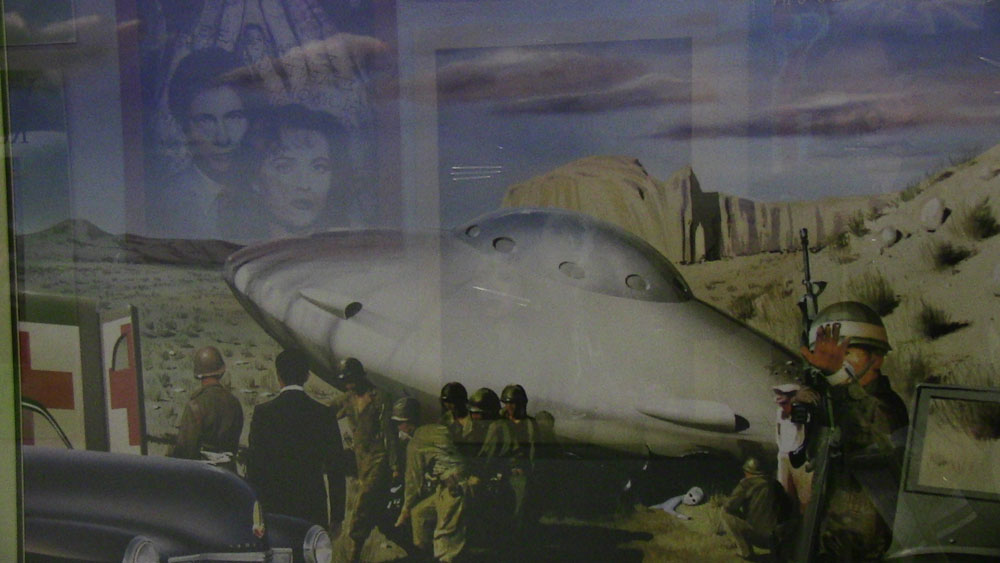
An illustration of the incident can be found at the Roswell UFO Museum. (Courtesy of Roswell UFO Museum)
EL PASO – Rapidly moving and unusually powerful storms do hit the southwest of United States from time to time and one of them struck near Roswell, NM, in the late hours of July 4, 1947.
An aerial craft of unknown design was attempting to cross a rather desolate area some 75 miles northwest of Roswell when it was hit by a powerful bolt of lightning, according to witnesses, and crashed. So began a series of events that have had repercussions to this day.
Interview with Julie Schuster, Director of the Roswell UFO Museum
0:00 / 0:00DownloadRight-click and save as to download.

It should be noted that neither the craft nor the crash went unnoticed. Rancher Mac Brazel heard a loud noise different from the normal sounds of thunder. Two nuns at St. Mary’s Hospital in Roswell saw what they believed was an airplane crash in the distance. The tower at Roswell Army Airfield tracked the flight of the object and reported a “descending flash.” However, at the time no one knew just what had taken place.
The morning of July 5, 1947 Brazel went for the morning inspection of his range. Riding with him was his neighbor’s seven-year-old son, Dee Proctor. To his shock, they came upon a debris field 300 hundred yards wide and ¾ of a mile long. Brazel and his young helper dismounted and began to collect some of the smaller pieces of wreckage and soon filled a sack with what were described as strange pieces of metal.
The following morning Brazel went to see Sheriff George A. Wilcox in Roswell and made him aware of what had taken place. Wilcox, realizing he was out of his depth placed a call to the commander of Roswell Army Airfield, Colonel Blanchard who in turn alerted the base intelligence officer, Major Jesse Marcel. Marcel took a military sedan and followed Brazel out to his ranch. In 1947 over the primitive roads that crisscrossed the area, this was an all day trip so Marcel spent the night at Brazel’s ranch and on July 7, began the initial investigation of the crash site.
Marcel and Brazel spent the morning investigating the debris field and Marcel loaded his car with the strange material found at the site before leaving for town. Before returning to base, Marcel stopped by his home and his 11-year-old son Jesse Marcel, Jr. had the opportunity to handle the odd metal. Later Marcel showed his boss Colonel William Blanchard what he had found.
The military moved fast because the same day, July 7th Glenn Dennis, a local mortician got a call from Roswell Army Airfield asking about the number of child size caskets he had in stock and how soon he could get more. He was also asked how to preserve bodies that had been exposed to the weather. He answered questions as best as he could.
Later than day Dennis took an airman who had been riding a motorcycle and struck a cattle trick to the base hospital and at the emergency entrance saw an ambulance containing some strange items. Curious, Dennis went into the base hospital to see a nurse friend. She reacted strangely and told him to get out of there immediately. On the way out of the hospital he was stopped by military police and told he would die if he told anyone what he had seen.
The next day, July 8, 1947, Blanchard instructed 1st Lieutenant Walter Haut to issue a press release about recovering a flying saucer. At 2 p.m. the press release was issued and the world went nuts. The press release was later labeled a hoax by higher headquarters. That same day Colonel Blanchard sent Marcel and some of the debris to report to General Roger Ramey in Ft. Worth. Ramey had the debris spread out on the floor, sent Marcel out of the room and when he returned the debris he had brought had been replaced with pieces of a weather balloon.
Ramey ordered Marcel not to say a word, called in reporters and told them the weather balloon had been misidentified as a flying saucer.
At the same time, Brazel was held in custody by the military at Roswell and was “convinced” to modify his story to support the crashed weather balloon story. Brazel was not released until the afternoon of July 12th having been held in solitary for three days. Dennis met his nurse friend who drew him pictures of what he had seen on the examining table – a big-eyed alien. She had written down everything she could about what she had seen and heard. Shortly after this meeting, the next day, she was transferred to England and was then reported as having died. Ramey issued a press release to the Associated Press saying that the saucer story was just a weather balloon.
So ended the story of the alien crash at Roswell.
However, in the early 1990’s Stanton Friedman, a well-known UFO researcher and a nuclear physicist became aware of the story and began to investigate. The result was to become one of the best-known UFO events in the world.
Haut and Dennis opened the UFO museum and study center in Roswell. Every July 4 there is a UFO celebration in Roswell and the town is overwhelmed with visitors. This past year the UFO museum reported that more 150,000 persons visited the center, which have been so highly rated that NASA is in the process of lending it numerous artifacts that are integral parts of the history of man’s travels into space.
Did a flying saucer crash just outside of Roswell, New Mexico on July 4, 1947? Has our government conducted a cover up of the real facts for the last 65 years? The jury is still out, but if you have any interest in the question you should go to Roswell and visit the UFO Museum and Study Center.

Wednesday, April 4, 2012

Another Day

Well this semester is winding down and it has been interesting. Having been sent back to school to learn how to create videos has resulted in a number of new markets for my writing as well as several offers that I did not anticipate for employment and a number of requests that I speak at various events. I guess it is true that when it rains it pours. Beginning in late May I will be submitting a new story each week to Borderzine Magazine as well as a number of new publications and working on a short movie. Life is definitely getting interesting.
Till next time.

Tuesday, April 3, 2012

We Were Not The First


The first story that I wrote that appeared at http://www.borderzine.com was the following.

Did Europeans settle in the Arizona desert thousands of years before Columbus sailed to America?


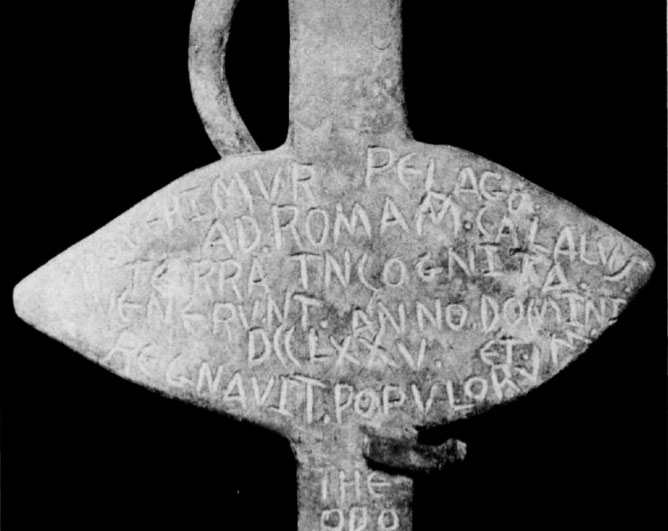
Engraved on the cross found in the Arizona desert c.1922 is the tale that after landing on the coast of the Gulf of Mexico, the Romans marched northwest until they arrived at a desert area near present day Tucson. (Photo from the Desert Magazine, December 1980.)
EL PASO – In our modern world we tend to think of stories of pygmies and giants, dragons and the wee people, hidden treasures and mysterious lost cities as fairy tales and bedtime stories, but these yarns have roots deep in the distant history of the American Southwest.
Almost 500 years before the arrival of Christopher Columbus, Leif Ericson explored the land west of Greenland and established a small settlement. More than 300 years before Columbus landed in Santo Domingo in 1492, a Welsh explorer navigated up Alabama’s Mobile Bay and established European styled fortifications and settlements as far north as the Ohio Valley.
But perhaps even they weren’t the first to come to the new world. Roman Christians may have established a colony on the outskirts of what is now Tucson, Arizona as far back as 775 A.D. Unfortunately, mainstream archeology and academia have dismissed these discoveries as either hoaxes or simply as unworthy of discussion. However, to their chagrin, such unusual discoveries continue to be made.
It might be hard to understand that there have been discoveries that would change the history books and our concept of ancient history, but established academia has gone out of its way to suppress such discoveries. There have been dozens of discoveries that make it very clear that there was once a relatively advanced civilization occupying North America of which only bare remnants remain.
When the European explorers landed on the eastern shores of this great land, they believed that it was untouched by man. Then the explorers met the scattered Indian tribes that inhabited the east. Most of the tribes in North America were small and ill prepared for the arrival of one of the greatest scourges of the old world – the religious zealot. The Conquistadors were bringing the word of God to the heathen of the New World whether they wanted it or not.
The arrival of the Spanish was not an accident; there was a legal basis for their move to the new world. In 1095, at the beginning of the Crusades, Pope Urban II issued an edict, referred to as a Papal Bull.
The first of these Papal edicts affecting the new world was called Terra Nullius (meaning empty land). This Bull gave the kings and princes of Europe the right to “discover” or claim land in non-Christian areas. This policy was further extended in the year 1452 when Pope Nicholas V issued a Papal Bull entitled Romanus Pontifex, declaring war against all non-Christians throughout the world and authorizing the conquest of their nations and territories.
These religious edicts treated non-Christians as uncivilized sub-humans, and therefore without rights to any land or nation. Christian leaders claimed a God-given right to take control of all lands and used these Papal Edicts to justify war, colonization, and even slavery of the people living in the conquered lands.
As detailed by Rick Osmon in Graves of the Golden Bear: Ancient Fortresses and Monuments of the Ohio Valley, by the time Christopher Columbus set sail in 1492, this idea, which was referred to as the Doctrine of Discovery, was a well-established concept.
The Spanish, acting on the assumption that there were no previous civilizations existing on the North American continent, rushed in to claim the “empty lands” granted them by the Papal Bulls. In spite of contemporary tales of others finding the new world, the Catholic Church through its major sponsors at the time, the Spanish court and the Jesuit brotherhood, were able to ensure that history would show that Christopher Columbus was the first to find the new world. Spain was his sponsor, and thus Spain was due a legal and rightful claim to the entire New World, including all riches and human slaves that could be found there.
However, during the initial exploration, to their chagrin, there were signs that there had been a pre-existing civilization. There was even evidence that there had been a pre-existing “Christian” civilization in North America. This fact, alone, if proven, would have thrown the ownership of this great land up for grabs as the Papal Bulls would not have applied to the new world.
Under the instructions of their religious “advisors,” the Spanish moved to eradicate the evidence of earlier settlements, thus making the new world safe for conquest.
Roman legions in Arizona
There is evidence that in 775 A.D. a fleet of ships carrying 700 Christianized Romans left the Roman Empire under the command of Theodorus the Renowned bound for the New World. The information regarding this colonial effort comes from an engraved cross that was unearthed near present day Tucson, Arizona.
According to the story engraved on the cross, after a landing on the coast of the Gulf of Mexico, the Romans marched northwest until, arriving at a desert area near present day Tucson, where they built a city that they called Terra Calalus. According to the records found, the colony flourished until approximately 900 A.D when the local Native American tribes that they had been oppressing for almost 125 years destroyed it.
Welsh visitors
The Romans were not the only Europeans to predate the arrival of Columbus. The Daughters of the American Revolution placed a most interesting plaque at Fort Morgan, Alabama few years ago commemorating the explorations of Prince Madoc, a brave Welsh explorer. A few historians have insisted that Prince Madoc and his followers landed on the shores of Mobile Bay in the year 1170, over 300 years before Columbus came to America.
At the unveiling of the plaque were Mrs. Mary Yale Williams, both a descendant of the Madoc family and a member of the family that founded Yale University, Hatchett Chandler, of Fort Morgan, at whose suggestion the marker was placed at the old fort and Miss Zella Armstrong of Chattanooga, author of Who Discovered America: The Amazing Story of Madoc, a book in which she concluded that Madoc was the first white discoverer of what is now the United States.
Many researchers have investigated the claim of Madoc and the 1170 date and a few have found substance in the claims. Much of the early research along this line centered on stories regarding “Welsh speaking Indians” that were purportedly of fair complexion and that used round boats built much more like Welsh coracles than like canoes. Indeed, several portraits and chronicle entries by early journalists, particularly by Meriwether Lewis and George Caitlin, appear to depict light skinned, blue-eyed people in native attire living among the Mandan tribe of the Missouri River country.
According to the story, hostile Indians killed Prince Madoc during an attack. Supporting this sad ending to the career of this brave individual was a discovery in Wales of an ancient chapel. During a renovation of this structure, a mural was found commemorating the death of Prince Madoc and in the mural the attackers were identified as feather wearing individuals who shot arrows at the Welsh explorers.
Ancient copper mines
According to the research of Philip Coppens in his work Copper: A world trade in 3000 BC? Predating even the arrival of the Welsh and the Romans, the era around 3000 BC saw more than 500,000 tons of copper mined from the so-called Upper Peninsula of Michigan. The largest mine was on Isle Royale, an island in Lake Superior, near the Canadian border. Here, there are thousands of prehistoric copper pits, dug thousands of years ago by an unknown ancient people.
The mining operation on Isle Royale was neither small nor primitive even by today’s standards. The Mining Belt on Isle Royale is one and three quarter miles in length and nearly four hundred feet wide. The copper pits range from 10 to 30 feet deep with a maze of connecting tunnels that one archaeologist estimated would have taken the equivalent of 10,000 men working for 1000 years to dig.
After two centuries of speculation, no one has ever satisfactorily explained either the identity of the miners or where all of this copper mined by these unknown miners went. Dating of the relics found at the site revealed that extraction of copper from Isle Royal began in 5300 BC, with some researchers even claiming that it began as early as 6000 BC. Evidence for smelting is known to exist from “only” 4000 BC onwards.
The exact amount of the mined ore is perhaps never going to be exactly determined, but what is known is that about 1200 BC, all mining activity was halted. But around 1000 AD, mining was restarted and lasted until 1320 AD. During this period more than 2000 tons of copper ore were removed.
So clearly, there were a fairly large number of inhabitants of some sophistication living in North America over 5,000 years ago and there were a number of explorers and settlers here long before Christopher Columbus “discovered” America for the Spanish Crown.
In future articles, we will examine not only these stories but other fascinating aspects that are numbered among the many mysteries that make the Southwest United States such a fascinating part of the country.
_____
Editor’s Note – This is the first in a series of articles that examines data showing that North America has been a crossroads for explorers from distant lands for more than a thousand years and that Europeans may have actually established colonies in America long before Columbus sailed the Caribbean Sea.


    Sunday, April 1, 2012

    School Spirits

    Here is my next publication at http://www.borderzine.com:

    Lingering memories of ghostly images and echoing pep rallies haunt El Paso High

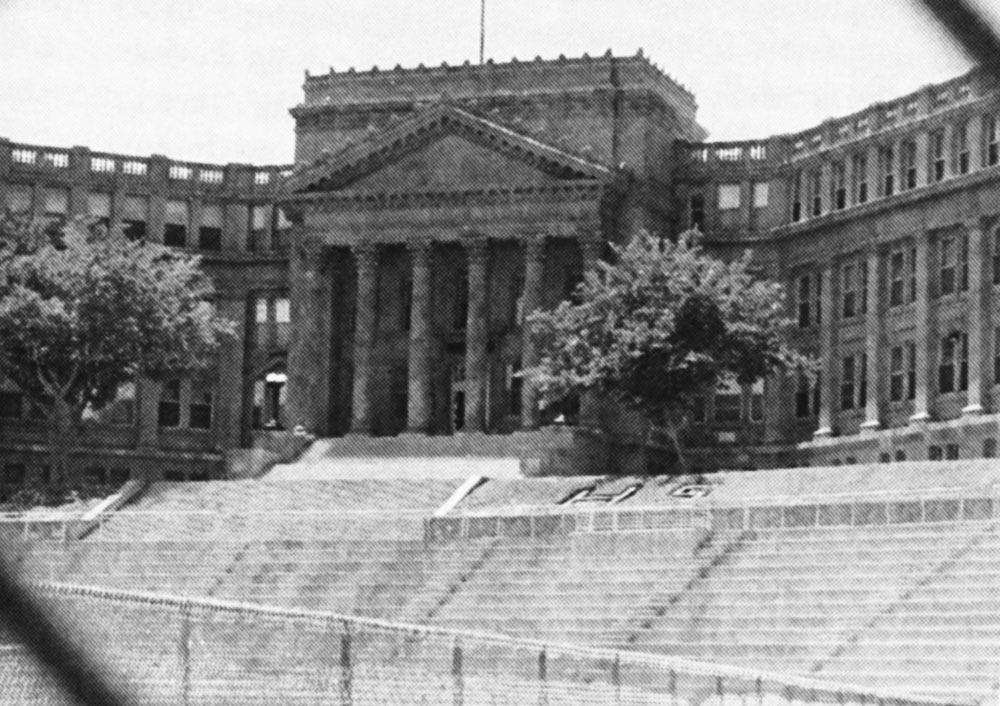
    Front of the El Paso High School building. (Ken Hudnall/Borderzine.com)
    Front of the El Paso High School building. (Ken Hudnall/Borderzine.com)
    EL PASO – It’s dark and late, usually around 2 a.m. when the faint notes of the Tiger fight song begin to sound, then, more clearly, cheerleaders cheering and students laughing, and stamping feet cascading into a pep rally – in a locked empty auditorium.
    You are hearing ghosts.
    “You might also think New Orleans is the most haunted city in the U.S but it is actually El Paso,” said Tobias H. “Toby” Tovar, 55, a math instructor at El Paso High School, “and El Paso High School is the most haunted building in town.”
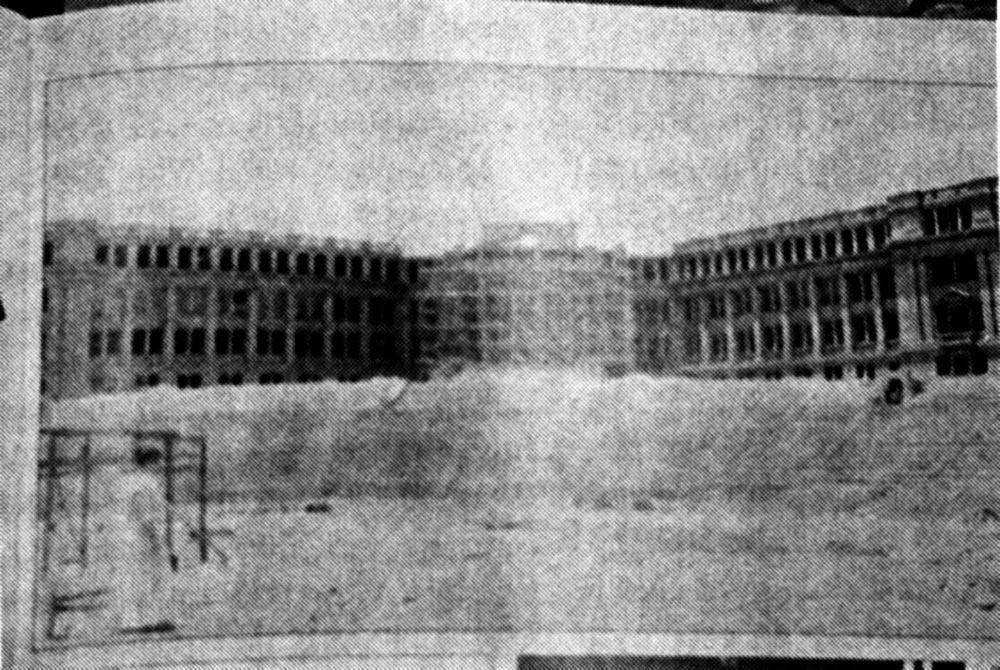
    El Paso High located at 800 E. Schuster, opened for classes in 1916 and since then “Lady on the Hill” has graduated many prominent citizens, and has captured hundreds of trophies, plaques, and championships in all fields.
    “Since the days of its construction, paranormal events have taken place at the school,” said Tovar. There have been numerous interior modifications designed to accommodate a growing student body and changing educational theories. As a result, a number of the original classrooms and hallways are no more, but there are stories that some of the modifications were done because of spirits that seem to have an affinity for certain areas of the building.
    It is said that there is a hall that leads to a balcony that is also closed off. People say they have seen an image of a girl jumping from the balcony. According to the story, every single day, mist and fog roam the abandoned hallway and there seems to be some “gooey-stuff” on the ceiling.
    This unusual activity stems from an incident that happened nearly 35 years ago when a distraught teenage girl killed herself by slitting her wrists and then, throwing herself from a balcony at the end of the hallway. There were been enough sightings that a wall was built completely closing the stairway leading up to the haunted hallway.
    However, this tragic young lady racing to her death is not the only unexplainable thing that has been seen at this historic school. Almost from the day it was constructed odd things have happened.
    In the recent El Paso High School yearbook, there is a reproduction of an old photograph showing a young lady in a white dress watching the original construction of the building in 1916. However, this unknown woman was not in the original photograph. Who was she and most importantly, how did she get in the picture?
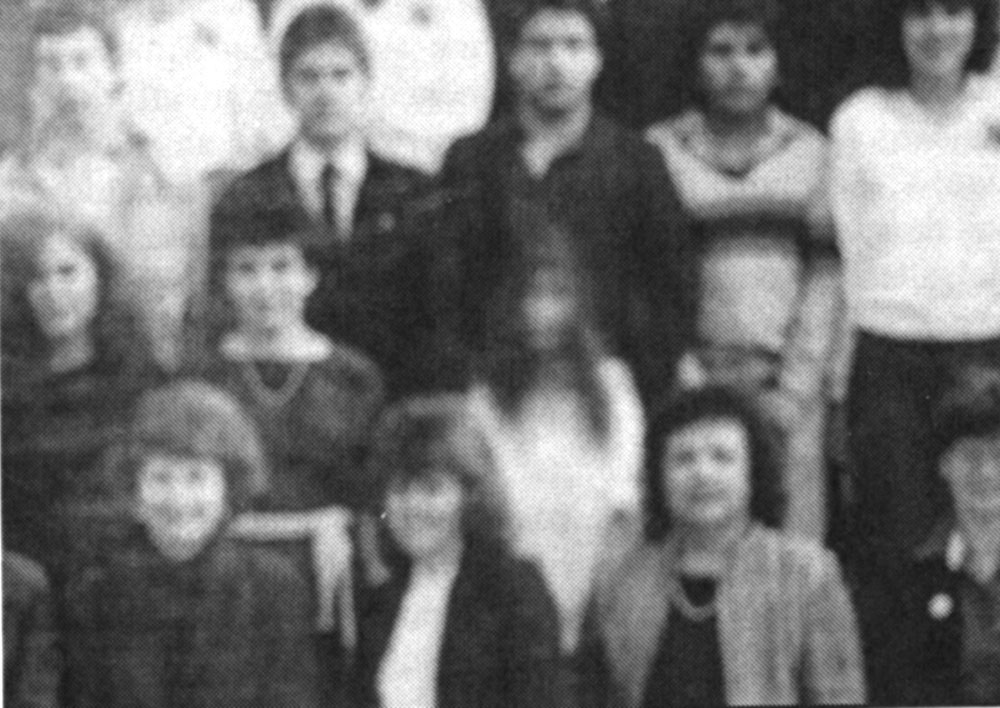
    1986 Graduating class - The girl on white was not in the original negative but is in the developed photo. No one knows who she is. (From the El Paso High public pictures)
    1986 Graduating class - The girl on white was not in the original negative but is in the developed photo. No one knows who she is. (From the El Paso High public pictures)
    A trophy case just inside the original front entrance of this grand old school contains a photo of the 1985 graduating class. “Everyone else in the photo shows up clear and distinct, but there is one young lady whose features are faint and fuzzy. Her image looks like it was inserted after the photo was taken,” explained Tovar.
    The figure in the picture is at the end of a row primarily of teachers. There are two young ladies, one toward the right end of the group and one on the left center of the group who are looking intently toward where this mysterious young lady is standing. Were these two young ladies perhaps the only ones sensitive enough to realize that something was wrong?
    This mysterious girl was not part of that particular graduating class and no one in the class that was photographed admitted knowing the identity of the girl. But regardless of how she got into the picture, she is very clearly in the photograph, a lovely, lonely looking girl, smiling for the camera.
    Tovar had a wealth of stories about events at the school. “About 15 years ago, it snowed in El Paso to the point that schools were closed. A few teachers and students had arrived before the closure announcement. Those teachers and students who had been able to make it to school were not allowed to leave due to unsafe road conditions. Having nothing else to do, a group of students and teachers, decided to explore the school starting with the tunnels in the basement,” he said.
    At one point, several of the teachers crawled through a small opening eventually coming to a brick wall that blocked the tunnel. The bricks were old and the cement between them was crumbling, but it was clear that these bricks had been added long after the surrounding brickwork. Curious, one of the teachers pushed on the newer bricks until some gave way, revealing a large dark cavity. Pushing a flashlight through the hole, they discovered a sealed off classroom.
    “This discovery surprised everyone as no one had even heard a whisper that there might be sealed off classrooms in the building,” said Tovar. The room was small and contained antique desks of the type seen in the television show Little House on the Prairie. There was no doubt that the classroom dated from the original construction of the building. The classroom was still set up with desks in place, texts and student notebooks still in place waiting for the students.
    “There were Baby Ruth candy bar wrappers on the floor from a time this product sold for 5 cents as well as numerous 5-cent coke bottles. In one of the student notebooks lying on a desk, they found, in addition to algebra notes and completed problems, a very racy love letter from the owner of the book to a boy,” he explained.
    There was a second sealed off classroom nearby, also ready to receive students, now filled with only dust and silence. Try as they might, they were never able to discover why, two classrooms would be sealed off so fast that they would not be cleaned of debris, desks nor texts nor the students be given time to claim their personal articles.
    The woman in the lower left hand corner was not in the original negative but is in the final photo. No one knows her identity. (From the El Paso High School public pictures.)
    The woman in the lower left hand corner was not in the original negative but is in the final photo. No one knows her identity. (From the El Paso High School public pictures.)
    The vast basement has been used as an overflow morgue during several of our nation’s wars. During World War II there were so many casualties shipped here that bodies had been stored in the basement until the next of kin could be notified. During the Spanish Flu Epidemic in the early part of the 1900s, so many died that the bodies were also stored in the basement of the High School.
    At one point in his career in the early 1980s, Toby Tovar was the basketball coach for the 8th grade basketball team. That year, the 8th grade team was undefeated and they were scheduled to play the only other undefeated team in the city. Each afternoon the 8th grade team had gym time scheduled from 5 p.m. to 7.p.m. in the gym immediately below his classroom. A disquieting event happened during practice one day.
    Just after they started practice, two waist-high access doors leading to the tunnels flew violently open, slamming back against the wall on either side. Naturally, the assumption eventually reached, even though there was little if any wind outside, was that a freak draft coming down one of the many chimneys had blown the latched doors open. The doors were shut and long heavy bench was placed in front of the doors to make sure that they would stay closed.
    “The kids had gone back to their scrimmage game and they were all at the far end of the court. At about 7 p.m., the bench went flying across the court and the doors, that had been securely latched, again flew open violently,” Tovar related. Suffice it to say that this team, made up of gang members who didn’t fear the devil himself, led by a coach who, in his youth had led two tough barrio gangs, decided to leave the building without even taking the time to turn out the lights.
    “A few years ago, Angelo Plecluda was the Journalism Instructor at El Paso High,” related Tovar. He and the yearbook staff, composed of journalism students, would work long into the night to produce a first class yearbook. One night he sent the last students home, and planned on being close behind them, but he had a few last minute things to do. It was almost exactly 11 p.m. when he finally left.
    According to Tovar, when Plecluda turned toward the exit, standing in the pool of dim red light thrown by the exit sign was a young lady wearing a blue chiffon dress of the type that would be worn to the School Prom in the 1940s or 1950s. Thinking it was one of his students, asked her what she was doing there and told her to go home.
    The girl turned and looked directly at him, her expression one of deep sadness. As he walked toward her, she began to become transparent and he noticed that she was not standing on the floor, but rather hovering in mid-air about a foot off of the floor. When he was only a few feet from her, she glided back into the deeper darkness of the hallway and disappeared.
    “Danny McKillip was a former All-American and has been inducted into the UTEP Miner Hall of Fame for Track and Field,” began Tovar. He was also Track Coach for El Paso High. One night in the late 1970s or early 1980s, Coach McKillip and the El Paso Track Team returned to the school very late at night after a track meet in Austin. The Track Teams’ locker room was in the area beneath Tovar’s classroom. The students came into the building to drop off their track gear and pick up their possessions they had left in their lockers.
    “The school was dark and silent when the buses arrived,” explained Tovar. As the students were gathering their possessions, McKillip suddenly heard the sounds of the Tiger Fight Song, cheerleaders performing their cheers and the sounds of a very spirited pep rally coming from the Second Floor Auditorium. Baffled, but thinking it might be a surprise reception for his Track Team that had just won the State Championship, Coach McKillip ran up the stairs to the second floor and, even though everything was dark, he dashed for the auditorium, a hundred feet away. Just as he reached the doors to the Auditorium, all of the sounds stopped. He found that the doors to the Auditorium were locked and he could no longer see nor hear anything.
    Coach McKillip unlocked the Auditorium and entered. He found everything dark and quiet. There was no sign that anyone had been there recently. Puzzled, more than ever, he returned to the locker room where some of his students were still waiting for him. No sooner had he rejoined his students than once again they all heard the sounds of the Tiger Fight Song, cheerleaders leading cheers and voices screaming. Followed by most of the remaining students, Coach McKillip dashed back up the stairs toward the Auditorium. Once again, halfway to the door, all sounds stopped, the school was dark and silent as a tomb.
    McKillip opened the Auditorium doors and he and his students searched the Auditorium for anything or anyone who could have made the sounds that they had heard. They found nothing. They returned to the locker room gathered their possessions and left the building.
    The building is steeped in history but it hides its secrets well. Doing modifications to the auditorium, workers removed the steps leading to the stage and found hidden, one or two books per step, an entire set of a Catholic Encyclopedia hidden beneath the steps. This set of books is complete, lavishly illustrated and a real treasure. How did they get inside those steps? Who put them there and most importantly, why were they placed in such an unusual hiding place?
    “El Paso High custodians quit their duties at 9 p.m. so unless someone is working late, after this hour, the massive building is deserted, the lights are out, and the alarms are set. The building is completely secure. But with El Paso High School, it can never be said with certainty that the building is deserted and secure. The restless dead walk the dark,” said Tovar.