Sunday, April 1, 2012

School Spirits

Here is my next publication at http://www.borderzine.com:

Lingering memories of ghostly images and echoing pep rallies haunt El Paso High

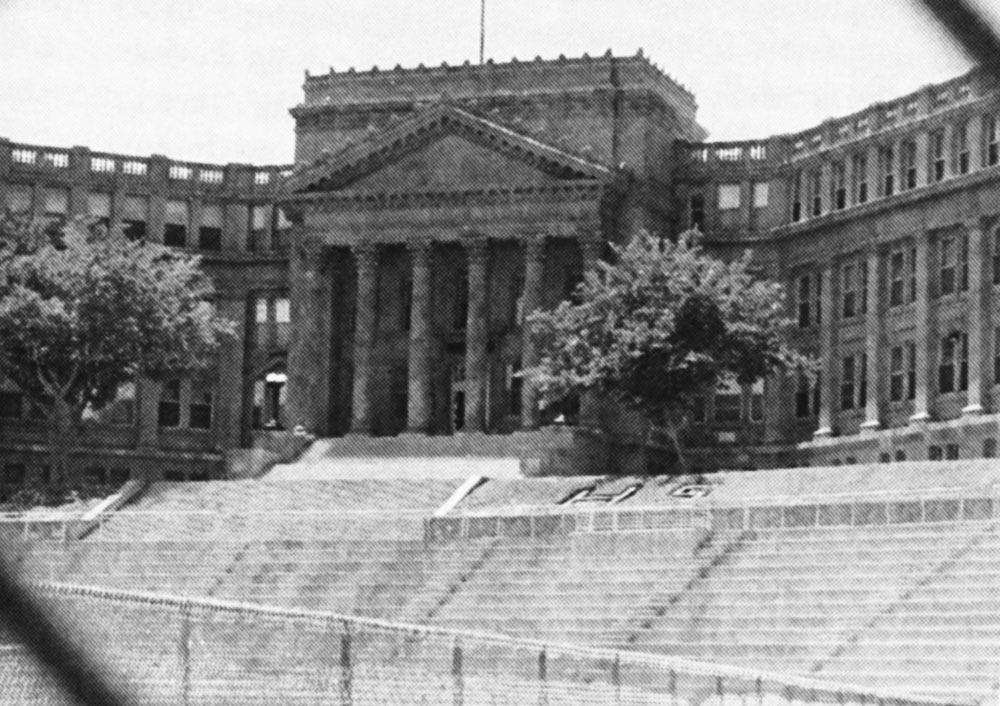
Front of the El Paso High School building. (Ken Hudnall/Borderzine.com)
EL PASO – It’s dark and late, usually around 2 a.m. when the faint notes of the Tiger fight song begin to sound, then, more clearly, cheerleaders cheering and students laughing, and stamping feet cascading into a pep rally – in a locked empty auditorium.
You are hearing ghosts.
“You might also think New Orleans is the most haunted city in the U.S but it is actually El Paso,” said Tobias H. “Toby” Tovar, 55, a math instructor at El Paso High School, “and El Paso High School is the most haunted building in town.”
El Paso High located at 800 E. Schuster, opened for classes in 1916 and since then “Lady on the Hill” has graduated many prominent citizens, and has captured hundreds of trophies, plaques, and championships in all fields.
“Since the days of its construction, paranormal events have taken place at the school,” said Tovar. There have been numerous interior modifications designed to accommodate a growing student body and changing educational theories. As a result, a number of the original classrooms and hallways are no more, but there are stories that some of the modifications were done because of spirits that seem to have an affinity for certain areas of the building.
It is said that there is a hall that leads to a balcony that is also closed off. People say they have seen an image of a girl jumping from the balcony. According to the story, every single day, mist and fog roam the abandoned hallway and there seems to be some “gooey-stuff” on the ceiling.
This unusual activity stems from an incident that happened nearly 35 years ago when a distraught teenage girl killed herself by slitting her wrists and then, throwing herself from a balcony at the end of the hallway. There were been enough sightings that a wall was built completely closing the stairway leading up to the haunted hallway.
However, this tragic young lady racing to her death is not the only unexplainable thing that has been seen at this historic school. Almost from the day it was constructed odd things have happened.
In the recent El Paso High School yearbook, there is a reproduction of an old photograph showing a young lady in a white dress watching the original construction of the building in 1916. However, this unknown woman was not in the original photograph. Who was she and most importantly, how did she get in the picture?
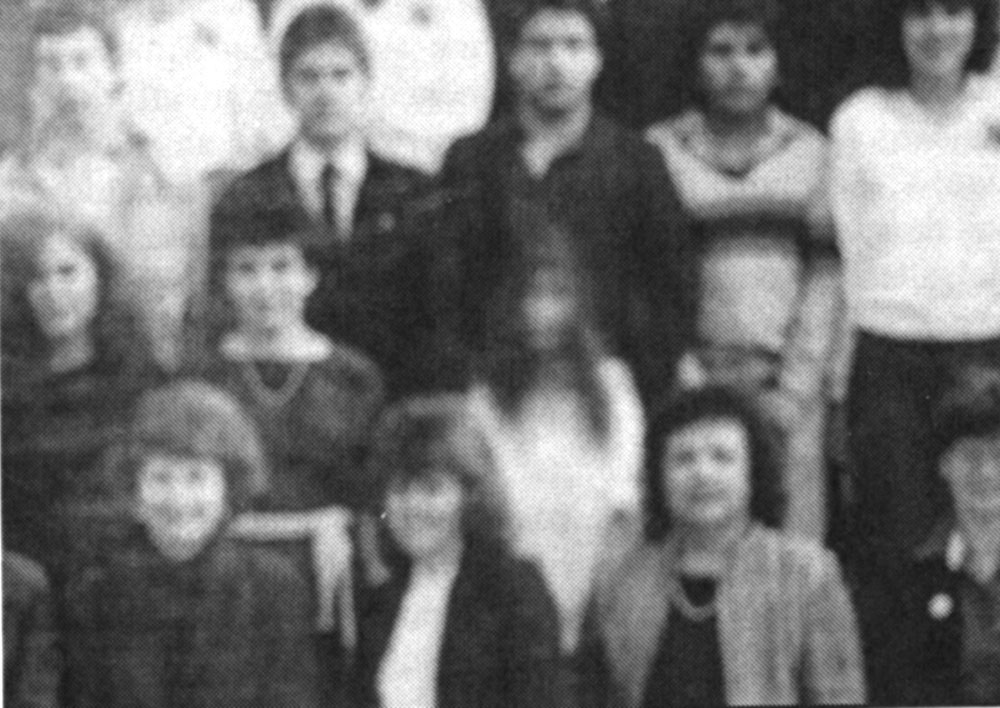
1986 Graduating class - The girl on white was not in the original negative but is in the developed photo. No one knows who she is. (From the El Paso High public pictures)
A trophy case just inside the original front entrance of this grand old school contains a photo of the 1985 graduating class. “Everyone else in the photo shows up clear and distinct, but there is one young lady whose features are faint and fuzzy. Her image looks like it was inserted after the photo was taken,” explained Tovar.
The figure in the picture is at the end of a row primarily of teachers. There are two young ladies, one toward the right end of the group and one on the left center of the group who are looking intently toward where this mysterious young lady is standing. Were these two young ladies perhaps the only ones sensitive enough to realize that something was wrong?
This mysterious girl was not part of that particular graduating class and no one in the class that was photographed admitted knowing the identity of the girl. But regardless of how she got into the picture, she is very clearly in the photograph, a lovely, lonely looking girl, smiling for the camera.
Tovar had a wealth of stories about events at the school. “About 15 years ago, it snowed in El Paso to the point that schools were closed. A few teachers and students had arrived before the closure announcement. Those teachers and students who had been able to make it to school were not allowed to leave due to unsafe road conditions. Having nothing else to do, a group of students and teachers, decided to explore the school starting with the tunnels in the basement,” he said.
At one point, several of the teachers crawled through a small opening eventually coming to a brick wall that blocked the tunnel. The bricks were old and the cement between them was crumbling, but it was clear that these bricks had been added long after the surrounding brickwork. Curious, one of the teachers pushed on the newer bricks until some gave way, revealing a large dark cavity. Pushing a flashlight through the hole, they discovered a sealed off classroom.
“This discovery surprised everyone as no one had even heard a whisper that there might be sealed off classrooms in the building,” said Tovar. The room was small and contained antique desks of the type seen in the television show Little House on the Prairie. There was no doubt that the classroom dated from the original construction of the building. The classroom was still set up with desks in place, texts and student notebooks still in place waiting for the students.
“There were Baby Ruth candy bar wrappers on the floor from a time this product sold for 5 cents as well as numerous 5-cent coke bottles. In one of the student notebooks lying on a desk, they found, in addition to algebra notes and completed problems, a very racy love letter from the owner of the book to a boy,” he explained.
There was a second sealed off classroom nearby, also ready to receive students, now filled with only dust and silence. Try as they might, they were never able to discover why, two classrooms would be sealed off so fast that they would not be cleaned of debris, desks nor texts nor the students be given time to claim their personal articles.
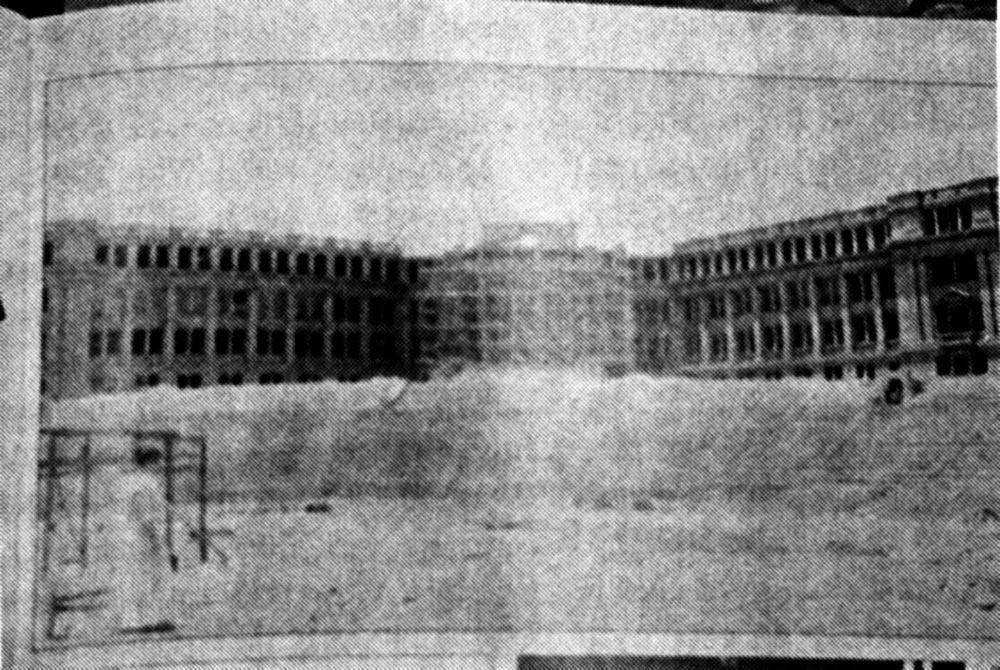
The woman in the lower left hand corner was not in the original negative but is in the final photo. No one knows her identity. (From the El Paso High School public pictures.)
The vast basement has been used as an overflow morgue during several of our nation’s wars. During World War II there were so many casualties shipped here that bodies had been stored in the basement until the next of kin could be notified. During the Spanish Flu Epidemic in the early part of the 1900s, so many died that the bodies were also stored in the basement of the High School.
At one point in his career in the early 1980s, Toby Tovar was the basketball coach for the 8th grade basketball team. That year, the 8th grade team was undefeated and they were scheduled to play the only other undefeated team in the city. Each afternoon the 8th grade team had gym time scheduled from 5 p.m. to 7.p.m. in the gym immediately below his classroom. A disquieting event happened during practice one day.
Just after they started practice, two waist-high access doors leading to the tunnels flew violently open, slamming back against the wall on either side. Naturally, the assumption eventually reached, even though there was little if any wind outside, was that a freak draft coming down one of the many chimneys had blown the latched doors open. The doors were shut and long heavy bench was placed in front of the doors to make sure that they would stay closed.
“The kids had gone back to their scrimmage game and they were all at the far end of the court. At about 7 p.m., the bench went flying across the court and the doors, that had been securely latched, again flew open violently,” Tovar related. Suffice it to say that this team, made up of gang members who didn’t fear the devil himself, led by a coach who, in his youth had led two tough barrio gangs, decided to leave the building without even taking the time to turn out the lights.
“A few years ago, Angelo Plecluda was the Journalism Instructor at El Paso High,” related Tovar. He and the yearbook staff, composed of journalism students, would work long into the night to produce a first class yearbook. One night he sent the last students home, and planned on being close behind them, but he had a few last minute things to do. It was almost exactly 11 p.m. when he finally left.
According to Tovar, when Plecluda turned toward the exit, standing in the pool of dim red light thrown by the exit sign was a young lady wearing a blue chiffon dress of the type that would be worn to the School Prom in the 1940s or 1950s. Thinking it was one of his students, asked her what she was doing there and told her to go home.
The girl turned and looked directly at him, her expression one of deep sadness. As he walked toward her, she began to become transparent and he noticed that she was not standing on the floor, but rather hovering in mid-air about a foot off of the floor. When he was only a few feet from her, she glided back into the deeper darkness of the hallway and disappeared.
“Danny McKillip was a former All-American and has been inducted into the UTEP Miner Hall of Fame for Track and Field,” began Tovar. He was also Track Coach for El Paso High. One night in the late 1970s or early 1980s, Coach McKillip and the El Paso Track Team returned to the school very late at night after a track meet in Austin. The Track Teams’ locker room was in the area beneath Tovar’s classroom. The students came into the building to drop off their track gear and pick up their possessions they had left in their lockers.
“The school was dark and silent when the buses arrived,” explained Tovar. As the students were gathering their possessions, McKillip suddenly heard the sounds of the Tiger Fight Song, cheerleaders performing their cheers and the sounds of a very spirited pep rally coming from the Second Floor Auditorium. Baffled, but thinking it might be a surprise reception for his Track Team that had just won the State Championship, Coach McKillip ran up the stairs to the second floor and, even though everything was dark, he dashed for the auditorium, a hundred feet away. Just as he reached the doors to the Auditorium, all of the sounds stopped. He found that the doors to the Auditorium were locked and he could no longer see nor hear anything.
Coach McKillip unlocked the Auditorium and entered. He found everything dark and quiet. There was no sign that anyone had been there recently. Puzzled, more than ever, he returned to the locker room where some of his students were still waiting for him. No sooner had he rejoined his students than once again they all heard the sounds of the Tiger Fight Song, cheerleaders leading cheers and voices screaming. Followed by most of the remaining students, Coach McKillip dashed back up the stairs toward the Auditorium. Once again, halfway to the door, all sounds stopped, the school was dark and silent as a tomb.
McKillip opened the Auditorium doors and he and his students searched the Auditorium for anything or anyone who could have made the sounds that they had heard. They found nothing. They returned to the locker room gathered their possessions and left the building.
The building is steeped in history but it hides its secrets well. Doing modifications to the auditorium, workers removed the steps leading to the stage and found hidden, one or two books per step, an entire set of a Catholic Encyclopedia hidden beneath the steps. This set of books is complete, lavishly illustrated and a real treasure. How did they get inside those steps? Who put them there and most importantly, why were they placed in such an unusual hiding place?
“El Paso High custodians quit their duties at 9 p.m. so unless someone is working late, after this hour, the massive building is deserted, the lights are out, and the alarms are set. The building is completely secure. But with El Paso High School, it can never be said with certainty that the building is deserted and secure. The restless dead walk the dark,” said Tovar.

Saturday, March 31, 2012

Writing for Borderzine

I have been a little slow writing on this blog, but I have an excuse, I have been writing stories for http://www.borderzine.com. The following is my most recent effort.

David Kaplan – A child in the Nazi concentration camps survives and forgives


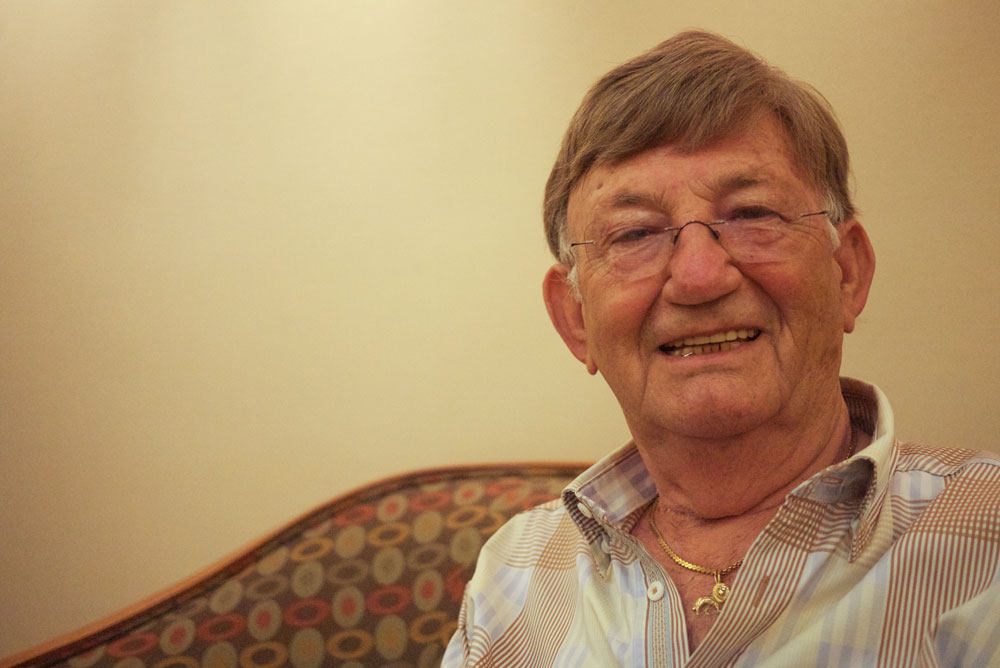
Kaplan survived four years in the Nazi concentration camps and was the only one from his family. (David Smith-Soto/Borderzine.com)

EL PASO – Loud demanding voices in the darkness of the early morning disrupting too few hours of sleep and waking to find that the man next to him is now a corpse mark the start of another stressful day in the Nazi concentration camp.

Hunger pangs continually tear at his stomach as he labors in the ever-present bone-chilling cold that cuts through the filthy rags he wears.

These are some of David Kaplan’s childhood memories.

“Families were torn apart, you never knew when it would be your turn to die,” said David Kaplan, 82. He told journalism students at the University of Texas at El Paso that he felt lucky to have survived the hell he fell into when he was only 11 years old.

These memories are alien to most of us in America today, seen only in old World War II movies. Even there, the actors are too well fed to be truly representative of those who spent anytime at all behind the electrified wire that fenced these camps. Under a continual death sentence that could be carried out at any time, most of us would be reduced to mental and emotional wrecks. But there are some who seem to be able to accept the situation, adapt, and if not thrive, at least survive.

On June 14, 1940 under the provisions of the Molotov-Ribbentrop Pact Russia occupied Lithuania, Kaplan’s homeland. At the time, he was eleven years old, living in the town of Kaunas with his father, mother, grandfather, sister and brother. His father was a tailor who employed eight other workers in the creation of tailor made suits. “We lived on the upper floors of the house that contained Kaplan’s Tailor Shop,” he explained.

Even prior to the Soviet occupation his relationship with his father was strained. His father was an alcoholic who beat his wife and then life under the Soviets was harsh. “I was happy when they took him away,” he remarked during the interview. Considered wealthy, his father was ordered to stop work by the Russians, the state would provide. However, Kaplan senior disobeyed and was arrested and sent to Siberia, leaving the family to shift for itself.

In 1941, Hitler declared war on the Soviet Union and invaded Lithuania. However, even before the arrival of German troops a group of Lithuanians began killing Russians and Jewish members of the population. “The partisans attacked the Jewish section of the city and killed over 10,000 Jews,” Kaplan said. On June 22, 1941 the German military arrived in Lithuania and put a stop to the violence. However, the peace was short lived, the calm before the storm, so to speak.

Before the Holocaust, Lithuania was home to almost a quarter of a million Jews and was considered one of the greatest centers of Jewish theology, philosophy, and learning in Eastern Europe. Unlike any other Nazi-occupied countries where the Holocaust was introduced gradually beginning with limiting Jewish civil rights, then concentrating Jews in ghettos, and finally moving the Jews to the death camps, executions in Lithuania started during the first days of war.

Researchers estimate that over that 80 per cent of the Lithuanian Jews were killed before January of 1942. The surviving 43,000 Jews were concentrated in the Vilnius, Kaunas, Šiauliai, and Švenčionys Ghettos and forced to work for the benefit of German military industry. However, on June 21, 1943, Heinrich Himmler issued an order to liquidate all ghettos and transfer any remaining Jews to concentration camps. Vilnius Ghetto was liquidated, while Kaunas and Šiauliai were turned into concentration camps and survived until July 1944. The remaining Jews were sent to camps in Stutthof, Dachau, and Auschwitz. Only about 2,000–3,000 of Lithuanian Jews survived to be liberated from these camps at the end of the war.

Due to widespread Lithuanian cooperation with the German authorities, the genocide rate of Jews in Lithuania, estimated to have exceeded 95% of the Jewish population, was one of the highest in Europe. Jews were widely considered to be responsible for the previous Soviet regime and were resented for welcoming Soviet troops. Targeted Nazi propaganda exploited the anti-Soviet sentiment and increased already existing, traditional anti-Semitism.

After initially gaining some control over the country, the Germans issued an edict giving all Jews in Kaunas 18 days to move to a small area called Slobotka. This was an area where the poor Jews used to live and the Germans wanted all Jews to move to this section of town. There was not enough space for all of the Jews, but Germans insisted the Jews move into this area anyway. They were told that they could exchange their homes in other parts of the city for a place to stay in the Jewish ghetto. The Kaplan family was forced to change their home with its shop and apartments for one room that lacked water or even plumbing. This one room had to provide shelter for David, 11, his brother, who was 16, his sister who was 14, his mother and his grandfather.

“The ghetto was surrounded by chicken wire and within its confines the Germans created a police force and a fire department staffed by Jews,” Kaplan said. A Jewish professional by the name of Dr. Hellkes was placed in charge of the ghetto and was the conduit between the Jewish people and the German authorities. “Life was hard in the ghetto, there was very little food and those confined to the ghetto were expected to work at the airport getting it ready for the influx of the German troops,” he explained. David’s mother and sister worked at the airport, but his brother was too sick to work.

The Germans kept adding Jews to the ghetto until overcrowding was a very serious issue. Dr. Hellkes complained to the Germans that there were too many people in the ghetto and was told not to worry that the overcrowding problem would soon be solved. Shortly troops and buses arrived and half of those in the ghetto were loaded onto the buses and taken away to the death camps. The other half was left to continue their work. Eventually, the ghetto was eradicated and the survivors sent to the death camps.

When Kaplan was 12, he was finally sent to the camp where the Jews were divided into two groups. The group on the left, the group to the right went to the barracks. Kaplan was originally selected for death, but he claimed to be an experienced shoemaker, which got him the opportunity to demonstrate his ability. In truth, his ability was minimal, but a kind worker suggested that he shine shoes to speed up the manufacturing process.

One morning, Kaplan, then 13, was working in the shoe shop when he saw several red buses with white paint covered windows enter the compound. He watched silently as the children left in the barracks while their parents were working, were rounded up by the guards and herded onto the buses, kicking, yelling and crying. Kaplan stayed hidden in the shoe shop and was spared. The children that were taken were never seen again. When the parents came home and found their children gone, they screamed in desperation and many killed themselves on the electrified fence.

Kaplan survived four years in the Nazi concentration camps. Along with his older brother, his mother and sister, he was shipped out of Lithuania in a railroad cattle car. In Poland, on the way to Germany, his mother and sister were separated from him and were marched into oblivion. He never saw them again.

Ending up in the Dachau camp near Munich, he was assigned to carry bags of cement.  His brother only lasted three weeks, but by using his wits and taking advantage of some lucky breaks, Kaplan managed to survive until the end of the war.

When Dachau was about to be liberated by allied forces on April 22, 1945, the camp survivors were marched toward the Swiss border to be exchanged for German prisoners. One morning, the survivors awoke to find their guards gone. Eventually a Wehrmacht Major approached and told them that allied forces were not far away and they should go to the nearest town. Shortly afterward, American soldiers discovered the survivors.

Eventually, more by luck than plan, Kaplan arrived at one of the resettlement offices and received permission to be resettled in St. Charles, MO. However, en route, his destination was changed to El Paso, which became his home. The boy who had his family torn from him has now been married for 60 years and has a large extended family.

After his liberation, Kaplan said, he decided to survive psychologically as well as physically and he found it in his heart to forgive the Germans. He didn’t want to carry hatred with him for the rest of his life, he said, but he still maintains that his story should be told lest people forget the Holocaust.

Thursday, March 22, 2012

History and Mystery

Nice of you to join me again, I am trying to make time to write something everyday, but it is tough. The Ken Hudnall Show is building listeners and new books are coming. In July I will be presenting "UFOs and the Paranormal" at the Roswell UFO Convention. The presentation will be at the UFO Library and Study Center.
I would also point everyone to my History and Mystery Tours every Saturday night beginning at the Camino Real Hotel. On these tours we cover unsolved mysteries, lost treasures and ghosts in and around downtown El Paso, Texas. Beginning at the Camino Real, we discuss the mysteries of the hotel, the Plaza Hotel, the Plaza Theater, White House, Mills Building, Library, Chase Bank, the Cortez Building, the old Popular Building, the Acme Saloon and then we are back at the Hotel. It will fascinate and mystify.
Oh, I have had further communication with representatives of the Central Intelligence Agency. It has been officially decided that I am not too old and perhaps my skill set is of the level that they would like to acquire. I had a telephone conference with the same individual who did not have time for me and the 30 minute call turned into an hour and a half of discussion regarding opportunities for the me with the CIA. Who knows, perhaps it is a route.
Until next time, good day.

Monday, March 12, 2012

An Out of This World Trip

Since I am writing for several outlets in addition to my book writing, I spent the weekend in Roswell, New Mexico doing a story on the UFO Museum and Study Center. It never ceases to amaze me how much people love the topic of unidentified flying objects. For my new stories check out http://www.borderzine.com.
I also want to make mention of the fact that there has been no response either from the University or from the Central Intelligence Agency (CIA) regarding the age discrimination issue. So much for supporting the vet.

Saturday, March 10, 2012

What's Too Old?

Well, it's me again. I don't have enough time to add to this blog every day, but I will make time in the future. Something happened Tuesday, March 6, 2012 that I think is applicable to everyone who has been around for a while. I was discriminated against based on my age.
I don't know if I have mentioned it but I have returned to school to learn how to make movies. I am attending the University of Texas at El Paso (UTEP). The classes have been very useful and the school does make every effort to help you prepare for the work force. Of course, I retired ten (10) years ago so that has really been relatively unimportant to me. However, since I am a disabled veteran and have a somewhat extensive professional background, when I was invited to a meet the Centrial Intelligence Agency (CIA) meeting I went. That was my first mistake.
When the two CIA personnel arrived, a man whose only name was Mark and a young lady whose only name was Kim, I asked if my age would be a problem. Mark said age would not be an issue and asked me about my background. When I mentioned military service he kind of snorted and said that was irrelevant, which I found insulting. I am a 100% disabled veteran and I can assure you my military service was not irrelevant and should have been a plus for a government agency like the CIA.
Next, the room was too small for all of the people that showed up and they were initially unable to show their video. While they were waiting for the University tech folks to get things going I went up to Mark and asked him a couple of questions. I noticed that the two were making individual appointments with people and I asked for an appointment. Mark told me they were not making appointments, even though he had just  made one and had the list of open times in his hand. I responded that I had just seen him make an appointment and he assured me that I had not. Clearly he did not want anything to do with me even though he knew nothing of my background and based on the ages of those in the room my qualifications were far greater than anyone else in the room. Finally, in the face of such a negative attitude from this man I left.
I went to the University Provost office and filed a complaint regarding what had happened and it was referred to Dr. George Barton head of the University Career Center. He sent me an email asking what had happened and I responded with what I have laid out here. When I told him that Mark had informed me that individual appointments were not being made, Dr. Barton informed me that Mark and Kim had been the entire next day having individual appointments with people from that original meeting. At this point in time it is clear to me that I was lied to by Mark for reasons unknown. I might also point out as a disabled veteran I have a 10  preference for any government job I apply for. However, apparently the CIA marches to a different drummer and has no use for those who have served their country.
After I explained everything to Dr. Barton he asked if I minded if he contacted the CIA about what happened. I told him that was fine. So there you have it - at 59 I am too old to serve my country once again. That being the case, how old are the Repulican nominees? How old is Vice President Biden, or Secretary of State Hillary Clinton or for that matter President Obama? At what point does age and experience cease being relevant? Why would the CIA rather hire pretty college girls (besides the obvious reason) and wide eyed naive students who believe they can single handedly save the world rather than someone who has more experience than most of them have years?
I had believed, based on everything the University has said up to this point, that qualifications were the basis for these meetings now I see that it is not the case and am saddened by that knowledge. I am also baffled that the CIA treats this country's veterans in such an off handed disrespectful manner. Mark could have told me that I was too old, or too tall or he didn't like me, which was clear from the beginning. He did not have to lie to me about the individual appointments. So much for equal opportunity and all of President Obama's rhetoric about supporting the veteran.

Friday, November 25, 2011

The New Ken Hudnall Show

Well the Ken Hudnall Show is now back in full force. After the illegal actions of David Candellaria in removing me from his station to appese an unset Congressman who didn't want anyone talking about his illegal campaign contributions, I moved my show to first Blog Talk Radio where I rebuilt my audience. The problem is that the system was hacked almost nightly and the hackers did everything possible to disrupt. One was of the hackers was even prosecued by the Feds for violations of the Patriot Act but this did not stop the rest of them. Interestingly enough I also received a number of death threats from these hackers but neither the FBI or anyone else cared since, as I was informed by the US Justice Department's Civil Rights Division, I am not a member of a protected class.
From Blog Talk Radio I was invited to move my show to Soup Media Network. This was a good move until one of the admistrators went off the rail and started forcing shows off the network that did not march to his crazy tune. I moved to Border Land Radio Network which is allowing me to run my show as I see fit. Now we are broadcasting Monday through Friday, from 6:00 PM to 9:00 PM Mountatin time (that is 8:00 PM to 11:00 PM Eastern time).
Join us as we inerview some of the biggest names in the world of the paranormal and the bizarre. Additionally I want to point out that we are doing history and mystery tours every Saturday night at the Camino Real Hotel. We also have available discounted hotel rooms which also offer free well drinks and a discount on your next meal at Azulajo Reasurant.

Sunday, November 20, 2011

We Are Back

Both the Ken Hudnall Show as well as this blog are back. Our new network is http://www.borderlandradio.com/. We are still talking about unsolved mysteries, lost treasures and ghosts. Additionally, we are interviewing a large number of authors from all genres. Join us each evening from 6:00 PM - 9:00 PM Mountain time (8:00 - 11:00 PM eastern time) for some of the best conversation on the internet.